“Love is ____. Explain.”
This was the writing prompt from Gina Barreca’s legendary prose-writing class at UConn that started it all. At the time, I was a returning drop-out who’d cleaned hospital rooms in the ICU during the pandemic. Several years older than my peers and life-hardened, I assumed these youngsters would approach the prompt with characteristic naiveté, landing their opinion immodestly on one of two emotional extremes depending on how recently they’d been dumped; love was either the best thing in the world or a terrible, betraying illusion.
I strove for a sharp satire that evaded this duality, but I was never satisfied with my response. I might be better off like them, I thought, and began to investigate why I avoided nightlife and social spaces. Later and grumpy, I joked to a friend that I was triggered into depression “whenever I see young people having fun.” He scoffed, “well, there’s nothing you can do about that.” And to this, I bitterly replied, “let me cook.” I began expanding my response to the “Love is ____” prompt into the long-form comic Relapse of a Recovering Ego Addict, aware that my ego was hugely involved (primarily its indignation about things) and that along the way it’d have to step aside in order for the project to be motivated by something more wholesome than the annihilation of joy. And the project would be self-aware about this and about all of its contradictions. Always leading with humor and empathy, the project has grown into a provocative exploration of the ways human adolescence has become dangerously complicated by ulteriorly-motivated social and technological forces of our consumerist Digital Age.
The process is thorough and revisions have been extreme. Today, there is only one sentence in common with the initial prose draft of 2022. All others have been replaced or removed… (I will write a post about this last-remaing sentence at some point.) As grueling at it is, I love it. I am motivated by the fact that this graphic memoir is on the very edge of my creative capacities, occupying my entire skillset (even demanding I cultivate new skills). Here are a few ways the project challenges me and therefore might occupy prospective readers in a similarly gratifying way.

This is a multimodal comic. Some graphic novels are done in India inks, others in Copic marker, others painted digitally. While these are comic standards for a reason (favoring quick renderings; clean and smooth appearance; vibrant and readable panels), my favorites are those that explore unconventional mediums, like Emil Ferris’s My Favorite Thing is Monsters, drawn entirely with ballpoint pens on lined notebook paper. Adam Hines’s under-celebrated Duncan the Wonder Dog has beautiful chapter interludes collaged from repurposed paper and found objects. Allison Bechdel is a famously literary graphic memoirist, offering up many hand-drawn panels depicting passages from books that her narrator is reading and being influenced by. A mentor of mine, K.C. Counselor, introduced me to a gripping memoir technique of including documents that pertain to one’s medical past: a technique he employed in his graphic memoir collection Between You and Me. Immediately, I tore through my own archives to find doctor’s notes and discharge documents that I’d later incorporate into my project.
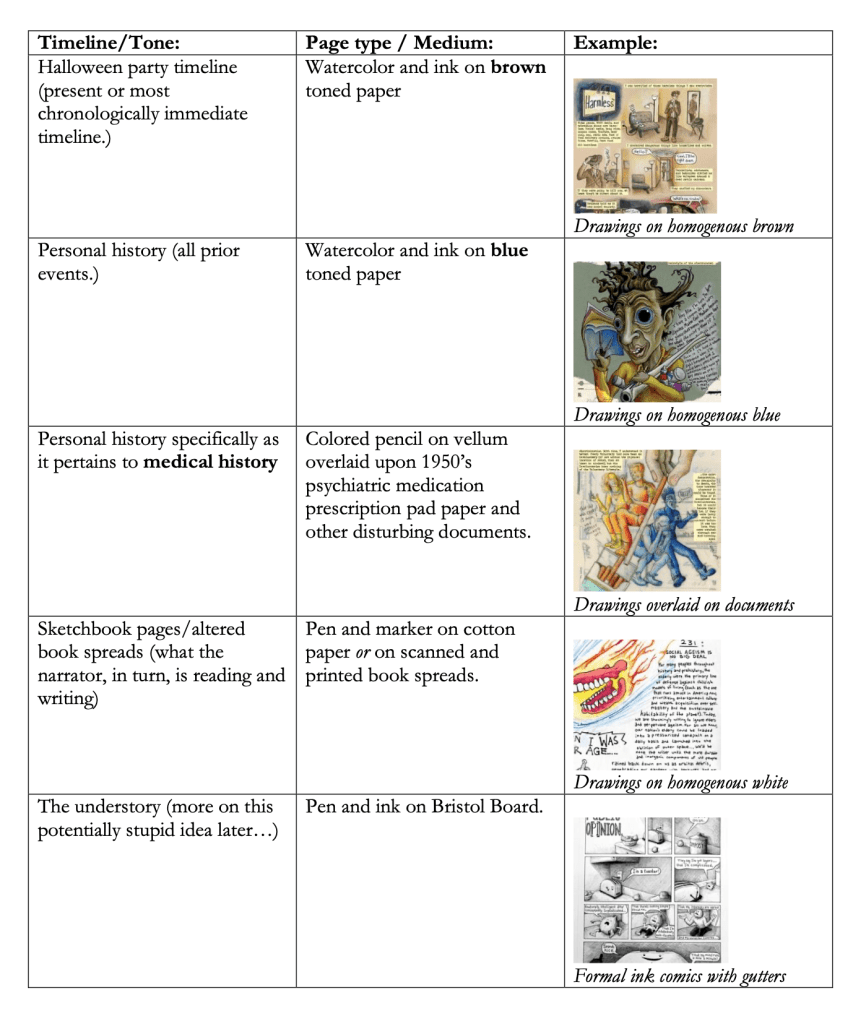
Jumping from medium to medium is something seen mostly in collections—each short comic stand-alone and rendered in its own medium and style—like Spiegelman’s early experimental comics, Breakdowns: Portrait of an Artist as a Young %@&*!. Each page you turn, the color pallet, style choice, medium, and aesthetic principles shift. These juxtapositions continuously illuminate their author’s voice from new angles. Fascinated by multimodality, I wanted Relapse of a Recovering Ego Addict to push this premise as far is it could go within a single extended narrative. It’s a densely woven, unchronological narrative that explores six or seven modalities in an alternating arrangement. One timeline occurs entirely within the context of a Halloween party and is painted in watercolor on brown-toned paper. Watercolor on blue-toned paper signifies the time before the Halloween party, while colored pencil on transparency vellum overlaid on prescription pads from 1950’s sanitariums signifies the time before the Halloween party specifically as it relates to the narrator’s institutionalizations. There are also sections of marker on cotton paper (signifying that we’ve entered the narrator’s personal sketchbook) and altered book scans signifying that we’re inside of the narrator’s personal library—each scanned and printed book page extensively annotated in acrylic (both inks and paint pens) to the extent that the original prose is nearly illegible (what remains legible promises Bechdelian insight into what the narrator has been reading and how that has shaped him). Still other mediums, including more traditional greyscale comics with gutters, are explored within an elucidating set of interludes.
Is this too much? I don’t think so. As a comics reader, when you turn a page and see that everything is suddenly rendered differently, you think “what’s going on?” As long as the change isn’t gratuitous, and something is going on—a shift in timeline or plot line—then this becomes an asset: a cue for the reader and a touchpoint for the larger rhythm of the piece. At least, that’s the theory I’m testing. Here’s an early “key” I made to assist peers and beta-readers in understanding my intention while things were still mostly in pencil (and thus the final intended medium of each page wasn’t readily apprehended at a glance.)
This is a multi-disciplinary comic. Heavily influenced by philosophy and psychology, this is, technically (and I never cared for genre distinctions), a graphic fictionalized-memoir. It situates itself between fiction and reality, deliberately muddling the idea of truth based upon one enduring and endlessly interesting fact of neuropsychology: the mind does not believe what is true but what it repeats. And this believing marks the brain in several tangible ways. We are all classically conditioning ourselves constantly; the only choice we get is the level of intentionality we apply to this classic conditioning. (As a therapist friend once said of the purpose of her work, “if change is inevitable, it might as well be growth.”) Since much of this conditioning plays out on the plane of storytelling—the stories we tell ourselves about ourselves—this comic understands itself not as an aesthetic end but as an aesthetic means to a neuropsychological end, specifically a creative representation of neuroplasticity. In other words, though it perhaps sounds a little evil, I hope this project destabilizes its readers’ sense of self (in ways ultimately freeing). Some psychiatrists like C.G. Jung held storytellers in very high esteem, finding their occupations not entirely dissimilar. (This challenges me because I’m no exception—my sense of self is often destabilized in expansive yet taxing ways.)
This comic is inconvenient. Like Kurt Vonnegut’s errand to buy just one envelope, this project takes its time and thinks it through. Yes, it would be faster to compose it digitally on a drawing tablet. Yes, it would be faster to build an asset library of forms and backgrounds to copy-and-paste. Yes, it would be faster to spell-check it with AI. But it would also be far less interesting for me, so I remain a rebellious anachronism. My favorite revisions come from agonizing over typos. Hand-drawing everything on paper results in deeply human aesthetics. Knowing that I can’t copy-and-paste panel backgrounds encourages every square inch to be entirely unique. Sitting through inconvenience and composing everything on paper is an essential ingredient for my artistic ingenuity. Ideas blooms from free time and spaciousness—two things our technologically top-heavy consumer society steals from us en masse. It is my hope that the inconvenience of this comic is instantly recognizable in its aesthetic, reflecting an earnest and uncompromising effort towards humanity.
For the above reasons and others, this project will take quite some time to complete yet holds my interest and attention steadfastly. If Relapse of a Recovering Ego Addict interests you, too, please follow along. I have built much infrastructure to allow the year 2026 to be devoted to this project. Current progress will always be shared on my homepage and through these monthly posts. My Instagram, too, is a great place to follow along.
Thank you for reading!
 John Guillemette
Leave a comment